

Higher Seroconversion Compared with Chinese Origin Hepatitis A Vaccines: A Real-World Clinical Study
In this article
Summary
Key points
- Hepatitis A poses increased risk in patients with chronic liver disease, where superinfection can result in severe complications2
- Real-world clinical data provide broader evidence of vaccine performance across diverse populations, beyond controlled trial settings4,6
- Inactivated hepatitis A vaccines achieve rapid seroconversion ~100% within 14 days (GMC: 138 mIU/ml, 95% CI: 120, 159), indicating strong early immune response7,8
- Live (Chinese-origin) vaccines show lower seroconversion rates and ~9% primary vaccine failure, indicating variability in response9,13
- Inactivated vaccines generate ~2-fold higher antibody titres (GMTs) compared to live vaccines, reflecting superior immunogenicity5
- Long-term protection with inactivated vaccines shows antibody persistence up to ~15 years, with modeled protection extending beyond10
- Live vaccines demonstrate lower long-term durability compared to inactivated formulations11
- Overall, inactivated hepatitis A vaccines offer more consistent, robust, and durable protection, supporting preferential clinical use5,10,11
Introduction
Hepatitis A remains a significant public health concern, particularly in regions with suboptimal sanitation and hygiene.1 Although the infection is usually self-limiting, it can lead to severe disease in certain high-risk populations, especially individuals with underlying chronic liver conditions such as Hepatitis B–related chronic liver disease (CLD).2 In such patients, acute hepatitis A superimposed on chronic liver disease has been associated with severe liver disease and increased morbidity and mortality.2
Hepatitis A vaccines have demonstrated excellent efficacy, and inactivated hepatitis A vaccines are strongly and rapidly immunogenic with infrequent and generally mild adverse reactions.3 Among these, vaccines manufactured in China have been increasingly utilized in clinical practice.3 However, the immune response to vaccination, particularly in patients with chronic liver disease, may differ from that observed in healthy individuals.2
Seroconversion, defined as the development of detectable antibodies following vaccination, serves as an important surrogate marker for vaccine-induced protection. Evaluating seroconversion rates in real-world settings is essential to understand the true effectiveness of vaccines across diverse patient populations.4 In this context, the present real-world clinical study aims to assess and compare seroconversion and immunogenicity outcomes between inactivated and Chinese-origin live Hepatitis A vaccines.5
Real-World Immunogenicity: Why It Matters Beyond Trials
For vaccines against Hepatitis A, it is important to understand how effectively they generate an immune response in real-life settings. Real-world studies help capture this by including a broader and more diverse patient population.6
Seroconversion as a Surrogate of Protection
Seroconversion means the development of detectable antibodies in the blood after exposure to an infection or following vaccination.4 In this context, it refers to the immune response generated after vaccination against Hepatitis A. It is used as a key endpoint because it provides a simple and reliable way to assess whether the vaccine is working. Instead of waiting to see if a person gets infected, the presence of antibodies indicates that the body has developed protection. Given the availability of different vaccine platforms, comparative evaluation of their real-world immunogenicity and durability is clinically relevant.
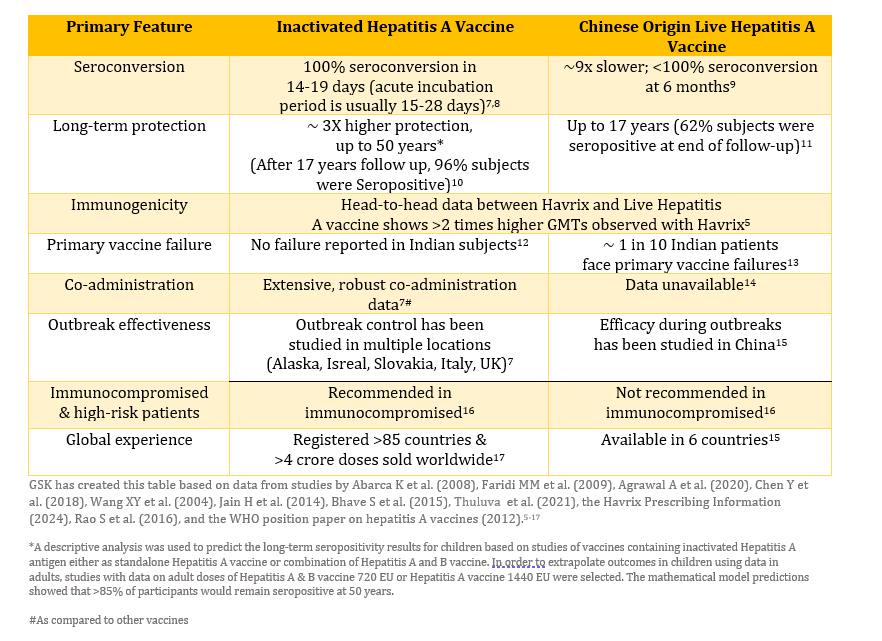
Comparative Immunogenicity and Seroprotection Outcomes: Inactivated vs Chinese-Origin Live Hepatitis A Vaccine
Comparative evidence highlights key differences in immunogenicity and long-term protection between inactivated and Chinese-origin live hepatitis A vaccines. The inactivated vaccine demonstrates rapid and robust seroconversion,7,8 sustained antibody persistence,5 and no reported primary vaccine failure.12 In contrast, the live vaccine shows comparatively lower seroconversion,9 reduced long-term seroprotection,11 and notable rates of primary vaccine failure.13
Conclusion
This comparative analysis demonstrates clear differences in immune response and durability between inactivated and Chinese-origin live Hepatitis A vaccines, with the inactivated vaccine showing stronger and more sustained protection.5,10,11 These findings highlight the importance of vaccine platform selection, particularly for populations at risk of severe disease.2 Prioritizing vaccines with higher and longer-lasting immunogenicity may help improve clinical outcomes and reduce the overall burden of Hepatitis A.10
Key Safety Information7
Contraindications
HAVRIX may not be administered to persons with a known hypersensitivity to a component of the vaccine, or to those who have shown signs of hypersensitivity during a previous administration of HAVRIX.
Adverse Effects
Very common - irritability, drowsiness, headache, pain and redness at injection site.
For the use only of Registered Medical Practitioners or a Hospital or a Laboratory
GMT: Geometric Mean Titer; EU: Enzyme-linked Immunosorbent Assay Units.
References
- Migueres M, Lhomme S, Izopet J. Hepatitis A: epidemiology, high-risk groups, prevention and research on antiviral treatment. Viruses. 2021;13(10):1900. doi:10.3390/v13101900
- Keeffe EB. Hepatitis A and B superimposed on chronic liver disease: vaccine-preventable diseases. Trans Am Clin Climatol Assoc. 2006;117:227-37; discussion 237-8. PMID: 18528476; PMCID: PMC1500906.
- Bonanni P, Boccalini S, Bechini A. Vaccination against hepatitis A in children: a review of the evidence. Ther Clin Risk Manag. 2007;3(6):1071-1076.
- National Cancer Institute. Seroconversion. In: NCI Dictionary of Cancer Terms. National Cancer Institute; Accessed May 21, 2026.
- Wang XY, Xu Z, Yao X, et al. Immune responses of anti-HAV in children vaccinated with live attenuated and inactivated hepatitis A vaccines. Vaccine. 2004;22(15-16):1941-1945. doi:10.1016/j.vaccine.2003.11.007
- Lo YC, Lee SS, Wong KH, Lim WL. Inactivated hepatitis A vaccine in healthy Chinese adults. J Intern Med. 1996;239(2):173-176. doi:10.1046/j.1365-2796.1996.442789000.x
- Havrix, Prescribing Information, Version: HAX/PI/IN/2024/01 Dated 10-Jun-2024.. https://india-pharma.gsk.com/media/qqmlvec5/havrix.pdf.
- Abarca K, Ibánez I, Perret C, Vial P, Zinsou JA. Immunogenicity, safety, and interchangeability of two inactivated hepatitis A vaccines in Chilean children. Int J Infect Dis. 2008;12(3):270-277. doi:10.1016/j.ijid.2007.08.006
- Faridi MM, Shah N, Ghosh TK, et al. Immunogenicity and safety of live attenuated hepatitis A vaccine: a multicentric study. Indian Pediatr. 2009;46(1):29-34.
- Agrawal A, Kolhapure S, Andani A, et al. Long-Term Persistence of Antibody Response with Two Doses of Inactivated Hepatitis A Vaccine in Children. Infect Dis Ther. 2020;9(4):785-796. doi:10.1007/s40121-020-00311-8
- Chen Y, Zhou CL, Zhang XJ, et al. Immune memory at 17-years of follow-up of a single dose of live attenuated hepatitis A vaccine. Vaccine. 2018;36(1):114-121. doi:10.1016/j.vaccine.2017.11.036.
- Jain H, Kumavat V, Singh T, Versteilen A, Sarnecki M. Immunogenicity and safety of a pediatric dose of a virosomal hepatitis A vaccine in healthy children in India. Hum Vaccin Immunother. 2014;10(7):2089-2097. doi:10.4161/hv.28631
- Bhave S, Sapru A, Bavdekar A, Kapatkar V, Mane A. Long-term immunogenicity of single dose of live attenuated hepatitis A vaccine in Indian children. Indian Pediatr. 2015 Aug;52(8):687-90. doi: 10.1007/s13312-015-0697-8. PMID: 26388627
- Biovac-A India. Prescribing information. Dr. Reddy’s Laboratories Ltd.
- Rao S, Mao JS, Motlekar S, Fangcheng Z, Kadhe G. A review of immunogenicity and tolerability of live attenuated Hepatitis A vaccine in children. Hum Vaccin Immunother. 2016;12(12):3160-3165. doi:10.1080/21645515.2016.1216286
- World Health Organization. WHO position paper on hepatitis A vaccines – June 2012. Wkly Epidemiol Rec. 2012;87(28-29):261-276.
- Data on File; 2023N531266_00;1-2.
GSK is not responsible for the third-party website content
Disclaimer
For the use only of a registered medical practitioner or a hospital or a laboratory. Trademarks are owned by or licensed to the GSK group of companies. Refer to full prescribing information before use. Registered medical practitioners can refer company website http://india-pharma.gsk.com/en-in/products/prescribing-information/ for full Product Information. Please report adverse events with any GSK product to the company at [email protected]. © 2026 GSK group of companies or its licensor. For more information, please contact: GlaxoSmithKline Pharmaceuticals Limited, Dr. Annie Besant Road, Worli, Mumbai – 400030 (India).
CL Code: PM-IN-HAV-WCNT-260009 | DOP: June 2026
For more information, please refer the following link
For Indian Healthcare Professionals Only
Key Safety Information
Contraindications:
HAVRIX may not be administered to persons with a known hypersensitivity to a component of the vaccine, or to those who have shown signs of hypersensitivity during a previous administration of HAVRIX.
Special warnings and precautions:
As in the case of other vaccines, HAVRIX will not be administered to patients with an acute febrile illness. A common infection does not constitute a contra-indication, however. HAVRIX may contain traces of neomycin. The vaccine will have to be used with caution in patients with a known hypersensitivity to this antibiotic. As with every product administered parenterally, it is recommended to prepare an appropriate medical treatment for immediate use, if an anaphylactic reaction were to occur. HAVRIX may be administered with persons who are HIV positive.
Undesirable Effects:
Very Common - Irritability, drowsiness, headache, pain and redness at injection site
For the use only of Registered Medical Practitioners or a Hospital or a Laboratory
Abbreviated Prescribing information of HAVRIX 1440 (ADULT) / 720 (JUNIOR)
Inactivated Hepatitis A Vaccine (Adsorbed) IP
ACTIVE INGREDIENT: HAVRIX1440: Each dose (1 ml) contains: Hepatitis A virus antigen (HAV) HM 175 strain, 1440 ELISA units (ELU); Aluminium (as aluminium hydroxide) 0.5 mg. HAVRIX720: Each dose (0.5 ml) contains: Hepatitis A virus antigen (HAV) HM 175 strain, 720 ELISA units (ELU); Aluminium (as aluminium hydroxide) 0.25 mg.
INDICATION: For active immunisation against infections caused by hepatitis A virus (HAV) for Children and Adolescents (from 1 year up to and including 18 years of age) and adults (from age 19 years and onwards). The booster dose may be given at any time between 6 months and 5 years, but preferably between 6 and 12 months after the primary dose.
DOSAGE AND ADMINISTRATION: Primary vaccination- Adults from age 19 years and onwards: A single dose of HAVRIX 1440 Adult (1.0 mL suspension) is used for primary immunisation. - Children and adolescents from 1 year up to and including 18 years of age: A single dose of HAVRIX 720 Junior (0.5 mL suspension) is used for primary immunisation. Booster vaccination- After primary vaccination with either HAVRIX 1440 Adult or HAVRIX 720 Junior, a booster dose is recommended in order to ensure long term protection. This booster dose should be given at any time between 6 months and 5 years, but preferably between 6 and 12 months after the primary dose. Method of Administration- HAVRIX must be injected intramuscularly only. It is recommended to inject the vaccine in the deltoid region in adults and in children. The deltoid muscle is not yet sufficiently developed in very young children, so the vaccine should be administered in the anterolateral part of the thigh. The injection must not be administered in the gluteal region subcutaneously or intradermally because the antibody response might be sub-optimal. However, the vaccine should be administered subcutaneously in patients suffering from thrombocytopoenia or subject to serious haemorrhage (e.g. haemophiliacs) because bleeding could occur after intramuscular administration in such persons. Strong pressure should be exercised at the site of the injection (without rubbing) for at least 2 minutes. The vaccine may never be administered intravascularly.
CONTRA-INDICATIONS: HAVRIX may not be administered to persons with a known hypersensitivity to a component of the vaccine or to those who have shown signs of hypersensitivity during a previous administration of HAVRIX.
SPECIAL WARNINGS and SPECIAL PRECAUTIONS: As in the case of other vaccines, HAVRIX will not be administered to patients with an acute febrile illness. A common infection does not constitute a contra-indication, however. People may already be in the incubation period of hepatitis A at the time of vaccination. In such circumstances, it is not certain that HAVRIX will prevent hepatitis A.
In patients undergoing haemodialysis and in subjects with a deficient immune system, the anti-HAV (hepatitis A virus) may remain insufficient after a primo-vaccination; in such patients, additional doses of the vaccine may have to be administered to attain an adequate antibody count. HAVRIX may contain traces of neomycin. The vaccine will have to be used with caution in patients with a known hypersensitivity to this antibiotic. As with every product administered parenterally, it is recommended to prepare an appropriate medical treatment for immediate use, if an anaphylactic reaction were to occur after the administration of the vaccine. For this reason, the vaccinated persons should remain under medical supervision for half an hour after vaccination. Syncope (fainting) can occur after any vaccination, or even before with adolescents in particular, as a psychogenic reaction to injection. This can be accompanied by several neurological signs such as a transient disturbance in vision, paraesthesia and tonic clonic movements of the limbs during the recovery phase. It is important that caution be set up to avoid injuries in the event of fainting. HAVRIX may be administered with persons who are HIV positive. Vaccination is not justified in subjects with anti-hepatitis A IgG.
This vaccine contains less than 1 mmol of sodium (23 mg) per dose, it is therefore essentially ‘sodium-free’. This vaccine contains potassium, less than 1 mmol (39 mg) per dose, it is therefore essentially ‘potassium-free’.
ADVERSE EFFECTS:
Clinical Trials: Frequencies, per dose, are defined as follows: Very common: ≥ 1/10, Common: ≥ 1/100 to < 1/10, Uncommon: ≥1/1000 to < 1/100, Rare: ≥1/10000 to < 1/1000, Very rare: < 1/10000.
Undesirable effects reported with HAVRIX Junior 720
Infections and infestations Uncommon: rhinitis. Metabolism and nutrition disorders Common: loss of appetite. Psychiatric disorders Very common: irritability. Nervous system disorders Common: drowsiness, headaches Very rare: neuritis, including Guillain-Barré syndrome and transverse myelitis. Gastrointestinal disorders_Common: nausea Uncommon: diarrhoea, vomiting Skin and subcutaneous tissue disorders Uncommon: rash General disorders and administrative site conditions Very common: pain and redness at injection site Common: swelling, malaise, fever (> 37.5°C) Uncommon: reaction at the injection site (induration)
Undesirable effects reported with HAVRIX 1440
Infections and infestations: Uncommon: upper respiratory tract infection, rhinitis Metabolism and nutrition disorders: Common: loss of appetite Nervous system disorders: Very common: headaches Uncommon: dizziness Rare: hypoaesthesia, paraesthesia Very rare: neuritis, including Guiliain-Barré syndrome and transverse myelitis. Gastrointestinal disorders: Common: gastrointestinal syndromes, diarrhoea, nausea Uncommon: vomiting Skin and subcutaneous tissue disorders Rare: pruritis Musculoskeletal and systemic disorders: Uncommon: myalgia, musculoskeletal stiffness General disorders and administrative site conditions: Very common: pain and redness at injection site, fatigue Common: swelling, malaise, fever (>37.5°C), reaction at the injection site (induration) Uncommon: influenza like illness Rare: shivering
Post-marketing surveillance
Immune system disorders: Anaphylactic reactions, allergic reactions, including anaphylactoid reactions and serum sickness like disease. Nervous system disorders: Convulsions Vascular disorders: Vasculitis Skin and subcutaneous tissue disorders: Angioneurotic oedema, urticaria, erythema multiforme Musculoskeletal and connective tissue disorders: Arthralgia
Version: HAX/API/IN/2025/02 v02 dated 03 Jul 2025
Registered medical practitioners can refer company website http://india-pharma.gsk.com/en-in/products/prescribing-information/ for full Product Information.
Please report adverse events with any GSK product to the company at [email protected]
For the use only of a registered medical practitioner or a hospital or a laboratory. Trademarks are owned by or licensed to the GSK group of companies. Refer to full prescribing information before use. Registered medical practitioners can refer company website: india-pharma.gsk.com/en-in/products/prescribing-information/ for Full Product Information. Please report adverse events with any GSK product to the company at [email protected]. ©2026 GSK group of companies or its licensor. For more information, please contact: GlaxoSmithKline Pharmaceuticals Limited, Dr. Annie Besant Road, Worli, Mumbai – 400030 (India).